Type 2 Diabetic. Cyclist Flâneur.   Coffeeneur.    Errandoneur
A bike / map geek with a gadget obsession and a high-viz fetish.
Showing posts with label Great Allegheny Passage. Show all posts

Tuesday, December 29, 2015

Planning a DC-Pittsburgh bicycle trip: Satisfice & Scrounge

bike trip planning DC to Pittsburgh
Yesterday's post, Planning a Pittsburgh to DC bike trip on the GAP and C&O Trail, offered a dozen questions about what you'd like to do. In this post, let's use your answers to inform your bike tour planning.


Who's Going?
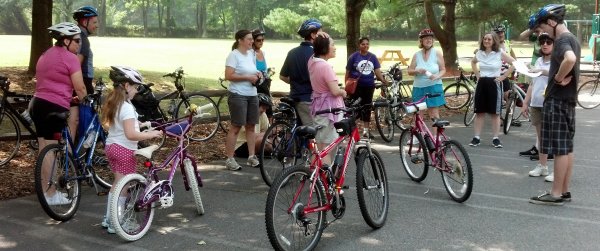
  • Three generations of my family
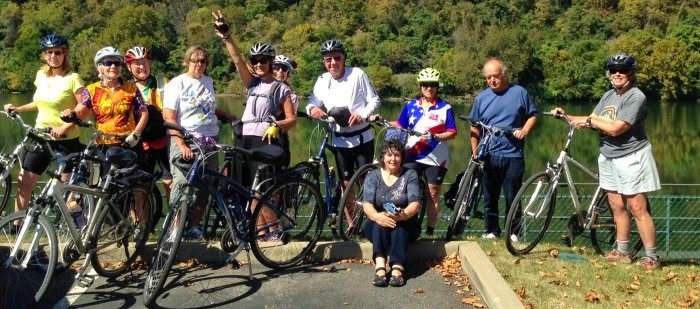
  • Eight members of my riding club
  • Four co-workers, their boss, and their spouses/SO's
  • Just me and my bike.
  Why? What's the reason for the trip?
  • Significant Life Event - retirement, marriage or divorce, career change
  • vacation
  • re-union
  • bucket-list
  • adventure

bike trip planning DC-Pittsburgh group dynamics

Some Bike Trip Planning Thoughts

If you're traveling solo, planning is easier because you only have to satisfy one person. But if you're traveling in a group, there are implications.

Every group faces some pressure on the trail - it might just be anxiety of a new experience, or physical discomfort. Those stresses will play out in the group dynamic. The relationships between friends and who-is-the-Alpha-dog may play out. It's to your advantage to acknowledge that your group is a social construct and that group dynamics will have implications for the ride leader.

The First Rule of Group Bike Trip Planning

If you're riding in a bicycle group from Pittsburgh to DC, here's a primary guide: It's a social construct. You should be friends before the ride, during the ride, and after the ride. There's no reason to bust up any relationships because of a failure to build-in success at the planning stage.

The Second Rule of Group Bike Trip Planning

the planner sets the stage for the success of the adventure. You want to stack the deck in favor of success by anticipating and resolving issues before anybody turns a pedal. Then the trip looks easy and people may say, what was the big deal? because you designed success into the plans.

Time, Distance, Victims These four questions will help you solve the most nuanced problem of bicycle tour planning: how long, how far, how many days? They all come into play.

What is the least proficient rider's enjoyable daily mileage?
  • 20 - 30 miles a day
  • 30 - 45 miles a day
  • 45-60 miles a day
  • remember: are you carrying your gear on your bikes?
   Will every rider ride every mile every day, or will one/some want the choice of opting out?
  • Every rider wants to ride every mile
  • We want the capability of one/some opting out of some segments
  • Our very young/old will want to jump into a van some days
  • Some of us (not a frequent rider, has a new hip) want to skip the long days
 
What's the enjoyable daily mileage for most of the riders?
  • 20 - 30 miles a day
  • 30 - 45 miles a day
  • 45-60 miles a day
  • 60-75 miles a day
  • remember: are you carrying your gear on your bikes?
   How many days do you plan to spend riding the trails?
  • I can only spend 4 days on this trip
  • 5 Days from Pgh to DC
  • 6 Days from Pgh to DC
  • 7 Days from Pgh to DC
  • 9 Days from Pgh to DC

Click here for a Duration Estimator.

Itinerary Step One: Timeframe For most groups, the length of time available is the most rigid factor. Between work, families, and other committments, and trying to get your group free during the same week, once you've chosen a NumberOfDays you're pretty locked into it.

Itinerary Step Two: 335/Days = DailyMiles This is superficially pretty easy. It's 335 miles from Pittsburgh to DC. Divide 335 by your Number of Days, and you'll get the average daily mileage to make your timeframe work.

  • 335/4 days= avg 84 mile days (two 75 mile days on the GAP, two 92 mile days on the C&O)
  • 335/5 days= avg 67 mile days (two 75 mile days on the GAP, three 60 mile days on the C&O)
  • 335/6 days= avg 56 mile days (3x 50 mile days GAP, 3x sixty mile days C&O)
  • 335/7 days= avg 48 mile days
  • 335/9 days= avg 37 mile days

Itinerary Step Three: Reality Check This is important. Compare your average daily miles (84, 56, 37) with your least proficient rider's comfortable daily distance. If your plan calls for 56 miles a day and Bertie is only good for 40 miles a day, it's not a good plan yet. What you've designed could be a failure for Bertie, unless you build a plan to accommodate your least proficient rider. It could be a support van. It could be an e-bike. There's a lot of approaches to accommodating that rider.

It's a disaster to design a situation that people won't succeed in without providing alternatives and accommodation. This is NOT survival of the fittest; this is vacation of the thoughtful. Unless you're training for an Ironman, in which case: roll on, brother.

Look at your options and resources: some of the group might only ride 20 or 30 mile days, or just the most scenic 20 miles, then jump in the van and meet the group at the hotel. Some might skip that one long day, take to the Spa and meet the group later. There's a lot of options.

The Third Rule of Group Bike Trip Planning: build a plan that's successful for everybody. Avoid re-enacting the Bataan Death March.

bicycle trip planning on the Great Allegheny Passage and C&O Trail from Pittsburgh to DC

Do you ride Pittsburgh to DC, or DC to Pittsburgh?

Which Way You Going, Billy? Between DC-Pgh and Pgh-DC, there is no 'best' direction. Often the decision will be made by the logistics of your situation; if you're flying in from Europe, land at IAD and start in DC. If you live in DC and want to ride back to increasingly known ares, ride Pgh-DC. It's up to you. If your logistics don't dictate your direction of travel, I recommend Pgh-to-DC for a few reasons:

  • For half the trip, the prevailing wind is from the northwest.
  • On the GAP, I like the slope of the climb-and-descent eastbound.
  • The C&O Trail is a series of 74 plateaus, give-or-take one for each lock. The plateaus are mostly level, and there's a 6-to-8 foot change in elevation at each lock. As far as direction on the C&O goes, I'd rather have seventy drops than climbs. Not crucial but a small factor.
But it works either way.

Here's another notion: The GAP is a modern, wide, very forgiving trail built with contemporary materials and modern engineering standards. The C&O is a Civil War donkey path with rocks, roots, puddles, and it doesn't drain well. If your goal is to ride 300 miles on a quality trail, then ride the GAP round-trip - in other words, Cumberland-Pittsburgh-Cumberland or Pittsburgh-Cumberland-Pittsburgh, and ride back to where you left you car.

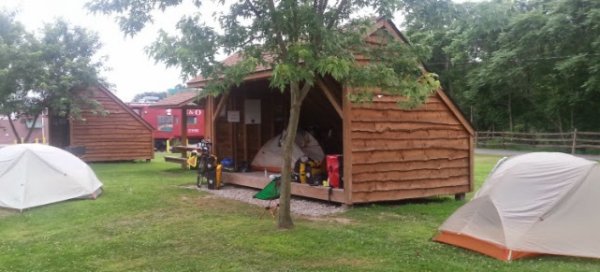
  • Camping
  • Hostels - Low Cost Motels
  • mid-range hotels and B&Bs
  • Glamping
  • upscale hotels
Confronting Constraints and Making Sausage Knowing who you've got, what your desired daily distance is, where you're staring and what direction you're riding, you're ready to build your itinerary. Begin at your choice of start-points, roll out the Desired Daily Mileage, and see what's on the map that's consistent with your Lodging Preference.

There won't be anything there. There never is. But wiggle around. A little further, or a little shorter along the trail, what sort of lodging is there? Do you have a support van (for accomodating Bertie the Short-Distance Rider, or carrying luggage) that you could use to shuttle the folks to a hotel? You begin satisficing, finding a suitable compromise that doesn't break any criteria and come close to satisfying most factors. And then you do the same for Days 2, 3, 4...


Pittsburgh - DC Bike Trip Planning Primer

The group is a social construct. You should be friends before the ride, during the ride, and after the ride.

The planner sets the stage for the success of the adventure. Stack the deck in favor of success by anticipating and resolving issues before anybody turns a pedal. Design success into the plan.

Build a plan that everybody will enjoy. Accommodate your weakest rider (which may include alternatives like a support vehicle). Every rider doesn't have to ride every mile; prioritize the scenic. Avoid re-enacting the Bataan Death March.

You'll never find the perfect lodging at your perfect distance; satisfice and scrounge; wiggle all the details. Do you Glamp for one night? Will that hotel come get you? Does your support vehicle bring new options?

In the words of Nobel-winner Herb Simon:* deciders can either 'find optimum solutions for a simplified world, or find satisfactory solutions for a more realistic world'. Satisfice and scrounge.


Please click here for info on our Pittsburgh-DC ChartPack:

Monday, December 28, 2015

Planning a Pittsburgh to DC bike trip on the GAP and C&O Trail

As in many things, a good framework of Questions leads to understanding and a satisfying outcome, so I thought I'd set down a 2016 update of Questions to Consider when planning a bike ride on the Great Allegheny Passage and C&O Canal Trail.
self contained and traveling light: 1 Aussie, 1 Kiwi, 1 Canadian, 1 from New Jersey

In their book Linking Up, Mary Shaw and Roy Weil identify four big initial decisions:
  • Daily Distance: How far should we ride each day?
  • Luxury: What kind of overnight accommodations do we want? Camping, hostels, B&Bs, hotels?
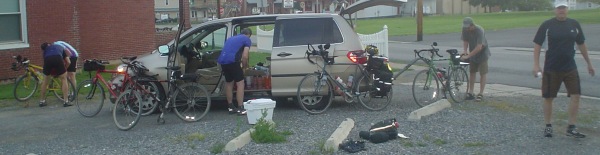
  • Support: Self-contained with panniers, lightly supported with a van, fully supported with an outfitter providing a guide?
  • Direction: Should we ride eastbound or westbound?
I'd like to expand on their framework a bit. Here's the initial questions I'd pose, and some sample responses to each.

Definitions
  • Who's going, and what's the nature of the relationships and the group dynamic?

    GAP and C&O group ride: group dynamics

  • Why? What's the reason for the trip?

  • What degree of involvement do you want in your trip planning and trip leadership?

Time and distance (335 miles)
  • What's the enjoyable daily mileage for the least proficient rider?


  • What's the enjoyable daily mileage for most of the riders?

    Pittsburgh - DC group bike trip


  • Flexibility Will every rider ride every mile every day, or will one/some want the capability of opting out?

    DC to Pittsburgh bicycle trip; group factors


  • Duration How many days do you plan to spend riding the trails?


Luxury
DC to Pittsburgh, PA bicycle trip planning - lodging, hotels, B&Bs
  • Where do you prefer to spend the evenings?

    DC to Pittsburgh PA bike camping or Glamping trip

Support
  • My problem-solving approach to the unexpected (weather, mechanicals, surprises) is:
  • problem solving, riding D.C. to Pittsburgh on a bike tour

  • How will you carry/move clothing and luggage?

    Pittsburgh to DC, GAP and C&O, support van

  • Are you going to use your own bikes, or rent bikes?

    bike tour: do you use rental or personal bicycles?

Direction:
  • What are your travel logistics? (new in 2015: you can roll your bike onto the Pgh-DC train!)
  • Do your particular logistics benefit from starting in either Pittsburgh or DC?

If you can answer those questions, you'll be well on your way to planning your DC to Pittsburgh bike tour. Tomorrow's post suggests ways to process the questions-and-answers presented here. Pittsburgh to DC bike trip, scenery: Salisbury Viaduct


Sunday, July 31, 2011

Overnight Bike Trip - S36O - Ohiopyle to Cumberland

Rode 75 miles in 7h15m (start-to-stop clock time), 5h23m (pedal-turning riding time).


Started at Ohiopyle at 1230. It's very crowded there in a summer Sunday afternoon, lots of people, lines for restrooms, etc. I couldn't find any obvious overnight parking so I used a relatively out of the way spot and left my car in it, hoping for the best.

The first leg to Confluence was crowded and congested, it was good to see all sorts of riders on all sorts of bikes. It was a mostly flat 11 miles to Confluence.

Confluence had a lot of people on bikes, mostly on the River's Edge - to - Town Square axis. The Confluence Cyclery (bike shop) offers free water, rest rooms, and an internet terminal, which is pretty cool.

Sidebar rant: I think that businesses that provide a sink or a faucet for free, and cool or bottled water for a fee, are supporting their customers and providing an ethical service. Businesses along a bike trail that only provide water for a fee are a bit too mercenary for me. When a place offers free water, I'll always leave a tip that exceeds what the same amount of bottled water would have cost, just to show that I appreciate their good will.

The cellphone coverage in Confluence is tremendously improved, another sign of the increased trail traffic affecting local conditions. Stopped at Sister's Cafe for a grilled ham-and-cheese sandwich (excellent). While I was in Confluence I kept an eye out for trail cartographer Bill Metzger, sort of like you'd keep an eye out for the Pope if you were touring the Vatican, but there was no Bill sighting.

The second leg to Rockwood saw the path pitch uphill a bit. It retrospect this may be the steepest segment of the admittedly friendly climb. Beautiful river views, I especially enjoy the ride around the Pinkerton Horn. I still saw other riders every five minutes or so. Entering the Rockwood trailhead there's a small "welcome" shack, and there's a low-power cellphone repeater under the eaves, which is very nice.

In Rockwood there's a trailside bike shop, I stopped in to check it out. They had a surprising amount of bike gear and water for sale (none for free). Rode into town for the Rockwood Opera House, had some ice cream and a Coke.

Departing Rockwood for Meyersdale the pitch seemed to level off. There was a downed tree across the path. Later I was very pleased to see two riders in the distance who turned out to be Pam and Bill Metzger, and it was a treat to get to spend a few minutes with them. They're both excellent people. Bill was riding his recumbent hand-crank bicycle, and Pam was riding a long-wheelbase recumbant, I think it was a Rans.


Saw the windmill farms and came upon the Salisbury Viaduct, wow wow wow what a view. It looks like the world was built to be seen from up there. The trail from the viaduct into Meyersdale is tremendously improved over the first time I was here. I decided to skip my stop in Meyersdale and press on to Frostburg, since at this late hour of the day my fave stop in Meyersdale (the GI Dayroom) would be closed.

Departing Meyersdale it was a nice climb to the Continental Divide followed by a wonderful descent. Rode through the (lighted) Savage Tunnel, the Mason-Dixon line, and the Borden Tunnel.

I was looking forward to stopping at Frostburg and marked one of the town's steeples above the treeline, but I missed the turn to the train station and ended up riding beyond the town. Since I'd skipped Meyersdale and now missed Frostburg, I ate a few powerbars and continued on to Cumberland.

This is the first time I've ridden the new trail between Frostburg and Cumberland, it's a very nice trail and the route into the city was car-free. I did lose my Droid's GPS signal on the east side of the Continental Divide, and I think a dedicated GPS with a twin-loop antenna would have done the job better.

There's a new hotel right on the trail in Cumberland, a Fairfield Marriott, it's a bit pricy but it is in a perfect location. They seem to grok the trail business, they had no objection to a bike in the room, and they even have a trailside bike washing station (a hose on a concrete pad, it could use an air pump, but it's a nice touch).

I got out of the shower at 8pm, just as the local restaurants close on a Sunday evening. I wound up eating at the world famous Queen City Creamery a few blocks away, which always has good food.

This was a really nice ride. The trail is in excellent condition, the bike did well (thanks to Ambridge Bike Shop on Friday), the weather was perfect, just good all around.